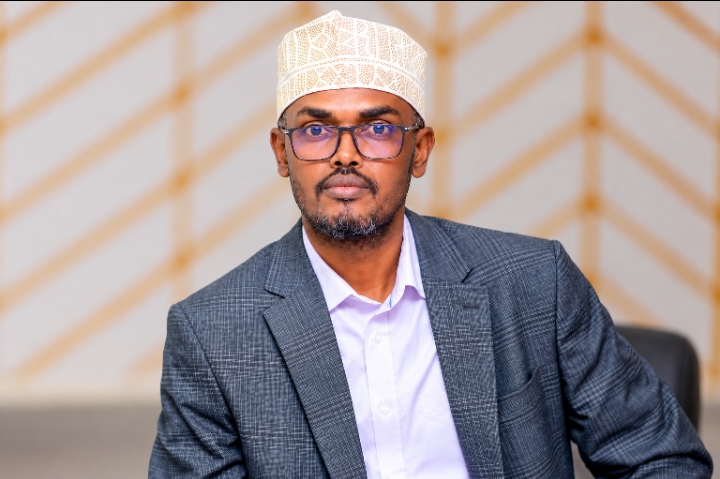
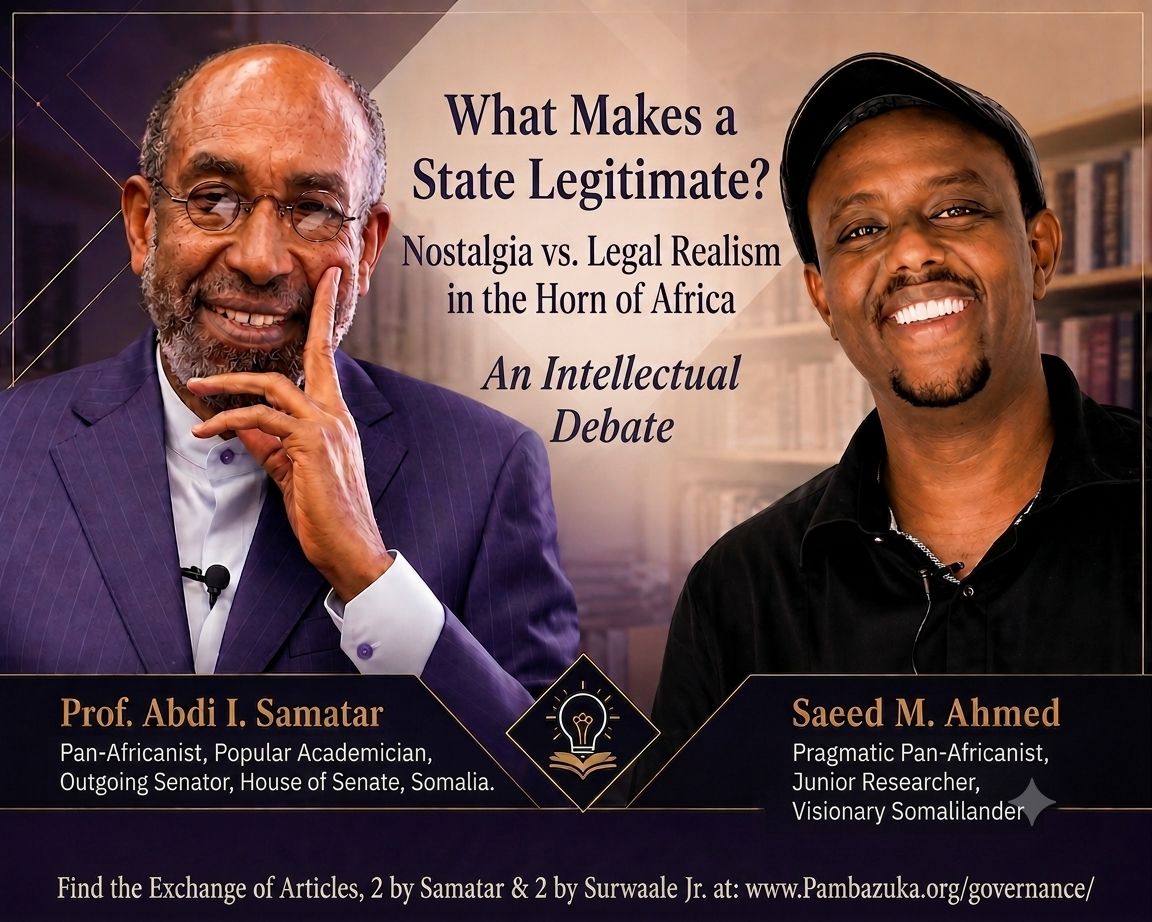
By Saeed Mohamed Ahmed
Abstract
In a widely circulated commentary series published by Pambazuka News—beginning with Professor Abdi Ismail Samatar's "Caged Somalia: Can It Be Liberated from Demonic Elite?" (2026), followed by Saeed Mohamed Ahmed's critique "Mogadishu's Blind Spot" (2026), and Samatar's subsequent rejoinder "The Sectarian Framework" (2026)—Professor Samatar denounces Somaliland's lawful reassertion of sovereignty as a "sectarian agenda" and likens its leadership to apartheid-era Bantustans. This definitive rejoinder responds systematically to his eight-point critique and demonstrates that Samatar's accusation is legally unfounded, historically distorted, and intellectually untenable. By elevating an unratified, asymmetrical 1960 union to sacred status while validating other post-colonial borders, Samatar practices the very selective logic he condemns. Grounded in uti possidetis juris, constitutional history, and the authoritative scholarship of Contini, Cotran, Adam, Mazrui, Bulhan, and others, this article dismantles Samatar's assertions and argues that the future of Horn of Africa scholarship demands legal realism, historical truth, and respect for self-determination.
I. The Accusation and Its Mirror
The intellectual exchange between this author and Professor Abdi Ismail Samatar across the pages of Pambazuka News addresses the core legal and political questions defining the Horn of Africa. Following my initial critique, "Mogadishu's Blind Spot," which examined the analytical oversights in Professor Samatar's earlier work "Caged Somalia," Professor Samatar published a response titled "The Sectarian Framework." That commentary closes with an incendiary analogy:
"The black South African administrators of the Bantustans agreed with the apartheid regime that the policy of tribal segregation was the natural way to govern South Africa. Such a sectarian agenda, and the bright future Africans and Somalis seek are oxymoronic!"
This comparison is rhetorical misdirection, not scholarly argument. It brands a democratic population as moral equivalents of apartheid collaborators. Yet this is the same territory that Professor Iqbal Jhazbhay characterized as "Africa's Best Kept Secret"—a nation that has earned this description "owing to its extraordinary achievements" in building peace and governance from the ashes of civil war.[^4] It is the same polity that the late Professor Ali Mazrui, one of Africa's most distinguished Pan-Africanist scholars, highlighted as a vital African model for reconciling traditional customary governance with modern democratic institutions.[^5] Mazrui, who visited Somaliland in 2006 and addressed its parliament, consistently maintained that Somaliland's claim to sovereignty is undeniable and urged Somalilanders to intensify their lobbying efforts in Commonwealth countries.
Examined through legal and historical realism, Samatar's framework reveals itself as the genuinely selective project: an ideology that sanctifies certain post-colonial borders while criminalizing others, ignoring foundational defects to preserve a nostalgic myth.
II. The Union Samatar Defends Never Legally Existed
Samatar's narrative rests on the premise that the 1960 Somali Republic was a legally binding union. The constitutional and legal record demonstrates otherwise.
On 26 June 1960, the State of Somaliland attained full international independence from the United Kingdom, receiving formal recognition from thirty-five UN member states. It fulfilled all four Montevideo Convention criteria for statehood—permanent population, defined territory, effective government, and capacity for foreign relations. When it sought voluntary union with the Trust Territory of Somalia on 1 July 1960, the process was marred by fundamental legal defects.
Paolo Contini—the UN legal advisor to the Somali Government and Chairman of the Consultative Commission for Integration from 1960 to 1965—explicitly acknowledged in his seminal work The Somali Republic: An Experiment in Legal Integration (1969) that "no committee had been appointed and charged with the official responsibility for drafting the legal instruments for the union, and there was hardly any time for consultations".[^6] Contini further concluded that "the Union of Somaliland and Somalia Law did not have any legal validity in the South," and that the "in principle" approval from Mogadishu was "not sufficient to make it legally binding."
Professor Hussein M. Adam—a distinguished Somali scholar born in Hargeisa, educated at Princeton and Harvard, and one of the most authoritative voices on Somali political history—documented that the Union of Somaliland and Somalia Law passed in Hargeisa was never enacted by southern authorities.[^7] In his definitive work From Tyranny to Anarchy: The Somali Experience (2008), Adam concluded that "the merger was illegal because an Act of Union was not approved".[^8]
This foundational flaw operated along two distinct lines:
First, the failure of dual-track ratification. The Union of Somaliland and Somalia Law adopted in Hargeisa on 27 June 1960 was never signed or enacted in Mogadishu. Conversely, Mogadishu's Atto di Unione was never enacted or ratified in the North. As legal scholar Eugene Cotran documented in his seminal 1963 analysis in the International and Comparative Law Quarterly, the validity of the instruments establishing the union was "questionable"—a single, legally binding treaty of union was never executed under international law.[^9] The two instruments were never reconciled; a presidential decree issued on 1 July to patch the gap was never presented to the National Assembly within the constitutionally required five days and lapsed by the constitution's own terms.
Second, the democratic rejection in 1961. When the unitary constitution was put to a national referendum in June 1961, northern territories demonstrated unequivocal rejection. In Hargeisa, 72 percent voted against; Berbera, 69 percent; Burao, 66 percent; Erigavo, 69 percent. Overall, over 60 percent of northern votes opposed the constitution.[^10] The leading Somali National League boycotted the vote entirely. In December 1961, junior Somaliland officers attempted a coup to restore their region's sovereignty; the court that tried them in Mogadishu acquitted them all, with the judge finding that they had never been sworn in for a country called the Somali Republic.
The legal identity of Somaliland was not extinguished by this unratified union. Rather, it was suspended under an arrangement lacking formalities required under international treaty law. When the central state collapsed amid state-sponsored violence in 1991—including the aerial bombardment of Hargeisa and Burao between 1987 and 1989 that killed tens of thousands—the people of Somaliland did not "secede" from a functioning nation. They dissolved an unratified, failed arrangement and reasserted sovereignty legally held on 26 June 1960.
III. Selective Pan-Somalism: The Djibouti and Ogaden Double Standards
If Somaliland's invocation of its 26 June 1960 borders constitutes a "sectarian crime," Samatar's framework exhibits profound double standards.
The Djibouti Precedent. When Djibouti achieved independence from France in 1977 within its colonial borders, Pan-Somali scholars accepted its statehood as pragmatic and valid. Yet when Somaliland reasserts the exact borders of its 1960 independence, it is framed as "tribalist." Validating statehood from French colonial borders while criminalizing statehood from British colonial borders is an indefensible double standard.
The Abandoned Mandate. The original Pan-Somali mandate aimed to unite all five Somali-inhabited territories. Centralist commentators remain silent regarding the Hawd Reserve Area and Ogaden-Somali territories permanently incorporated into Ethiopia. An ideology that attacks Somaliland's democratic consensus while accepting permanent incorporation of other Somali territories into neighboring states is political convenience masquerading as principle.
The OAU Framework. The principle of uti possidetis juris—codified in the 1964 Cairo Declaration of the Organisation of African Unity—mandates respect for international borders inherited at independence.[^11] Somaliland's boundaries are not tribal demarcations; they are internationally defined borders established through nineteenth-century Anglo-Ethiopian and Anglo-Italian treaties. Denying Somaliland's border validity while upholding identical borders elsewhere undermines the legal framework safeguarding peace across post-colonial Africa.
IV. The Bantustan Slur: A Forensic Refutation
Samatar's comparison of Somaliland to apartheid "Bantustans" weaponizes South African history in a manner factually perverse.
The Historical Reality of Bantustans. Bantustans were top-down, illegal enclaves engineered by the apartheid regime through the Bantu Authorities Act (1951). Their purpose was to strip Black South Africans of national citizenship and create rightless labor pools. They possessed no democratic legitimacy and were universally rejected under international law. As Mahmood Mamdani demonstrated in Citizen and Subject: Contemporary Africa and the Legacy of Late Colonialism (1996), indirect rule and tribal segregation were imperial technologies of control designed to fragment native populations—not organic expressions of self-determination.[^12]
The Empirical Reality of Somaliland State-Building. Somaliland's process represents the exact structural opposite:
● International Legality: Rooted in sovereign border demarcations of 26 June 1960 under uti possidetis juris.
● Indigenous Consensus: Established through grassroots peace conferences—Burco (1991), Borama (1993), Hargeisa (1997)—utilizing customary law (xeer) to construct modern institutions.[^13] The 1993 Borama Conference, which lasted four months, resulted in a comprehensive framework and roadmap that saw the transition from an interim military government to civilian administration.
● Democratic Validation: Endorsed by 97.1 percent in the 2001 constitutional referendum, with 99.9 percent of eligible voters participating. International observers confirmed the referendum was "conducted fairly, freely, and openly."
● Institutional Functionality: Maintains bicameral parliament, independent judiciary, regular multi-party elections, and biometric voter registration.[^14]
● Survival of State Terror: Rose from the 1988 aerial bombardments of Hargeisa and Burao by the very central government whose unitary model Samatar defends.[^15]
Comparing an indigenous democratic project to an apartheid puppet state is analytically absurd. The Black administrators of Bantustans enforced racial disenfranchisement; Somaliland's leadership rejected a violent, legally defective union to build a state founded on civic accountability.
V. Direct Responses to Samatar's Eight Queries
In "The Sectarian Framework," Professor Samatar posed eight specific analytical queries. Below is the systematic refutation of each:
First Query: Sool Conflict (2024)
The establishment of SSC-Khaatumo does not represent "secession" from Somaliland in any straightforward sense. These territories have been contested between Somaliland and Puntland since the 1990s, with clan loyalties cutting across administrative boundaries. The 2023–2024 violence reflects grievances over representation and resource distribution that Somaliland has struggled to accommodate in peripheral regions. To present this as evidence of "failure" applies a standard no post-conflict state—including Somalia—could meet. Somaliland has resolved multiple internal crises—including the 1992 Berbera conflict and 1994–1996 civil tensions—without descending into state collapse.
● Second Query: Central-Western Political Tensions
Somaliland's political system is explicitly designed to manage inter-clan tensions through institutionalized power-sharing. The 1993 Borama Conference integrated the Guurti as an upper house, ensuring non-Isaaq clans have formal representation and veto power. The peaceful transfer from SNM to civilian government under President Egal, with Gadabursi Vice President Abdirahman Aw Ali, exemplified this inclusivity. Tensions exist, but institutional mechanisms have repeatedly prevented escalation into catastrophic conflict.
● Third Query: Intellectual Lineage of Somaliland Scholarship
Samatar's dismissal of Somaliland literature as "functional anthropology" is a straw man. Scholars he dismisses—Bradbury, Walls, Renders, the Academy for Peace and Development—have produced work deeply critical of colonial frameworks, attentive to local agency, and grounded in extensive fieldwork.[^16][^17][^18][^19] Mark Bradbury's Becoming Somaliland (2008) provides a detailed account of why Somaliland has not followed Somalia into state collapse. Marleen Renders' Consider Somaliland (2012) investigates how traditional leaders and institutions help build legitimate governance. Michael Walls' A Somali Nation-State (2014) offers a strong rebuttal to the narrative of conflict and state failure typically attached to Somali politics.[^20] Their contributions document how Somalilanders draw on indigenous institutions to build functioning political order.
● Fourth Query: The Prisoner's Dilemma and Impoverishment
Samatar correctly identifies the collective action problem trapping Somali communities. But Somaliland's achievement is precisely to have escaped this trap—sufficiently to build functioning institutions, hold competitive elections, and maintain relative stability for over three decades. The existence of Somaliland's hybrid order demonstrates Somali communities can overcome the prisoner's dilemma when empowered to design their own institutions.[^22][^23] To collapse both cases into a single narrative of "tribalist elite ploys" misses the most important lesson.
● Fifth Query: Absence of Inspiring Leaders
Samatar's claim of absent inspiring leaders is subjective and refuted by the empirical record. Somaliland's trajectory has been shaped by leaders of considerable stature: President Muhammad Haji Ibrahim Egal, who forged pragmatic alliances and set the date for the 2001 constitutional referendum; the Guurti elders, who mediated conflicts; diaspora returnees who invested in peace. Samatar's dismissal reflects measurement against an idealized standard no political system could meet.
● Sixth Query: African Union and Neocolonialism
Samatar's defense of the AU oversimplifies a complex debate. Critiques of the AU's neocolonial inheritance are central to Pan-Africanist discourse. Kwame Nkrumah warned neocolonialism would "balkanize Africa."[^24] The OAU's founding compromise—"sanctification of colonial borders, doctrine of non-interference and implicit protection of incumbents"—constructed "a continental order designed less to generate strength than to suppress disruption."[^25] To raise these critiques is not to dismiss AU achievements but to insist Pan-Africanism be more than rhetorical commitment to inherited state forms. As the AU itself has acknowledged, the principle of uti possidetis juris was established in 1964 in Cairo precisely to avoid the multiplication of irredentist claims that could have destabilized newly established states. Properly interpreted, this principle may reinforce, not weaken, Somaliland's claim.
● Seventh Query: Somaliland-Israel Relationship
Israel's recognition of Somaliland (December 2025) was controversial, drawing condemnation from Turkey, Egypt, Saudi Arabia, the Organisation of Islamic Cooperation, and the AU.[^26][^32][^34][^36] However, Samatar's "cozying up" framing obscures strategic calculus: for three decades, Somaliland has sought recognition to unlock global financial institutions, formal assistance, and diplomatic legitimacy. Israel's recognition represents the first breach in diplomatic isolation constraining Somaliland's development. This is not to defend Israel's actions in Gaza—it is to insist moral judgment accompany analytical clarity about structural constraints facing unrecognized states.
● Eighth Query: Samatar's Senate Membership
Samatar's personal integrity does not settle empirical questions of Somaliland's institutional viability or normative questions of whether Somali unity should trump self-determination. These are questions of evidence and principle, not of character.
VI. Institutional Models: Dependency versus Self-Reliance
The Horn presents two contrasting governance models that illuminate fundamental questions about state-building in Africa:
● The Mogadishu Model (Federal Government of Somalia):
The security backbone of the Federal Government of Somalia has been sustained by foreign peacekeepers (AMISOM/ATMIS) for nearly two decades. Its financial basis remains highly dependent on foreign subsidies and bilateral aid. Its sovereignty has been compromised through agreements transferring maritime rights under foreign administration, such as the 2024 Türkiye agreement on defence and economic cooperation.[^27] Its democratic mechanics operate through complex indirect selection frameworks rather than direct universal suffrage.
● The Hargeisa Model (Republic of Somaliland):
Somaliland's security is maintained organically through internal security forces and police without foreign peacekeeping troops. Its financial basis relies on internal revenue generation, port revenues, and community funding.[^33] Its sovereignty is expressed through commercial infrastructure partnerships, such as the Berbera Port agreement with DP World, rather than the transfer of sovereign rights. Its democratic mechanics operate through universal direct suffrage, biometric voter registration, and regular multi-party elections.
This divergence highlights a central debate: Can genuine self-reliance be achieved through top-down models dependent on external security guarantees, or is it better realized through localized, organically funded governance structures commanding domestic legitimacy? Dr. Jamal Ali Hussein's study, published in the Cornell International Affairs Review (Spring 2026), revealed the core reasons for this divergence, echoing numerous scrutinies detailing the underlying rationales for this disparity.[^28]
VII. Conclusion: Beyond the "Sectarian" Smokescreen
Samatar's rhetoric moralizes away legal and historical realities. Somaliland's statehood is not a sectarian rebellion—it is a lawful reassertion of sovereignty grounded in uti possidetis juris, democratic consensus, and thirty-five years of indigenous peacemaking.
True sectarianism lies in an analytical framework that selectively sanctifies certain post-colonial borders while rejecting others, relying on inflammatory slurs to dismiss democratic self-determination. The study of the Horn requires moving beyond nostalgic abstractions toward legal realism, empirical evidence, and respect for demonstrated political will.
The Pan-Africanist tradition has always contained tensions between unity and self-determination, continental solidarity and local autonomy. Somaliland's case is neither simple clan particularism nor perfection without flaws. It is a national self-determination based on a rightful reassertion of a legitimate and historical sovereignty that was never discarded but stagnated for a period of time—it is a locally generated response to an unratified state collapse by communities marginalized, brutalized, and excluded. This marginalization of the State of Somaliland's peoplehood by the dysfunctional Somali Republic extends far beyond certain clans or communities but drastically affected the whole State of Somaliland's territory, as the rights of development and public service were irresponsibly tarnished from the entire people of Somaliland. An example is the lack of even one university across Somaliland territory, while the former Trust Somalia had a set of tertiary education centres including universities of different specializations.
Nevertheless, the state-rebuilding trajectory of Somaliland's process was an effort that was sometimes imperfect, contested, and incomplete. But that does not diminish its significance. This remarkable experience has been a home-grown, organic, locally-sustained, and persistently pursued project by Somalilanders, for Somalilanders, and from Somalilanders—unlike the tent-hosted, foreign-designed theatrics in Mogadishu. That is the reason Shaykh Musa Godad, Shaykh Abdillahi Shaykh Ali Jawhar, and their fellows thought, planned, and acted with confidence to host the 1993 People's Borama Grand Convention to set the foundations of an organic statehood process that was never and shall never seemingly be undertaken in Mogadishu. Though the same Senate/Guurti structure was attempted to be set up and serve the world-babysat administration over there.
To dismiss Somaliland with all its efforts and credentials as mere "tribalism" is to miss the most important story of post-conflict reconstruction in the Horn—and foreclose the possibility that Somalis themselves might chart their own path. The path forward demands legal realism, historical truth, and respect for democratic choices. Recognizing indigenous state-building does not weaken Pan-Africanism; it grounds African unity on democracy, legal consistency, and genuine self-determination.
Endnotes
[^1]: Abdi Ismail Samatar, "Caged Somalia: Can It Be Liberated from Demonic Elite?" Pambazuka News, Issue 1082, 2026. https://pambazuka.org/index.php/Caged-Somalia
[^2]: Saeed Mohamed Ahmed, "Mogadishu's Blind Spot: A Response to Prof. Abdi Ismail Samatar," Pambazuka News, Issue 1084, 2026.
https://pambazuka.org/index.php/Mogadishu-Blind-Spot
[^3]: Abdi Ismail Samatar, "The Sectarian Framework: A Rejoinder to Saeed Mohamed Ahmed," Pambazuka News, Issue 1085, 2026. https://pambazuka.org/index.php/Sectarian-Framework
[^4]: Iqbal Jhazbhay, "Somaliland: Africa's Best Kept Secret, A Challenge to the International Community?" African Security Review 12, no. 4 (2003): 77–82.
[^5]: Ali A. Mazrui, "The African State in the Third Millennium: In Search of Reconciliation," African Studies Quarterly 8, no. 3 (2006): 1–11.
[^6]: Paolo Contini, The Somali Republic: An Experiment in Legal Integration (London: Frank Cass & Co., 1969), 9.
[^7]: Hussein M. Adam, "Formation and Recognition of New States: Somaliland in Contrast to Eritrea," Review of African Political Economy 21, no. 59 (1994): 21–38.
[^8]: Hussein M. Adam, From Tyranny to Anarchy: The Somali Experience (Asmara: Red Sea Press, 2008), 187.
[^9]: Eugene Cotran, "Legal Problems Arising out of the Formation of the Somali Republic," International and Comparative Law Quarterly 12, no. 3 (1963): 1010–1026.
[^10]: Republic of Somalia Ministry of Interior, Official Results of the Constitutional Referendum of June 20, 1961 (Mogadishu, 1961).
[^11]: Organisation of African Unity, "Resolution on the Situation in Somalia," OAU Assembly of Heads of State and Government, Cairo, 26 June–1 July 1964.
[^12]: Mahmood Mamdani, Citizen and Subject: Contemporary Africa and the Legacy of Late Colonialism (Princeton: Princeton University Press, 1996).
[^13]: Rebecca Richards, Understanding Statebuilding: Traditional Governance and the Modern State in Somaliland (London: Routledge, 2014), 105.
[^14]: Sarah Phillips, When There Was No Aid: War and Peace in Somaliland (Ithaca, NY: Cornell University Press, 2020).
[^15]: Mohamed Haji Ingiriis, The Suicidal State in Somalia: The Rise and Fall of the Siad Barre Regime, 1969–1991 (Lanham, MD: University Press of America, 2016).
[^16]: Mark Bradbury, Becoming Somaliland (Oxford: James Currey, 2008).
[^17]: Marleen Renders, Consider Somaliland: State-Building with Traditional Leaders and Institutions (Leiden: Brill, 2012).
[^18]: Michael Walls, A Somali Nation-State: History, Culture and Somaliland's Political Transition (Pisa: Ponte Invisible, 2014).
[^19]: Michael Walls, "The Emergence of a Somali State: Building Peace from Civil War in Somaliland," African Affairs 108, no. 432 (2009): 371–389.
[^20]: Academy for Peace and Development, "Peace in Somaliland: An Indigenous Approach to State-Building" (Interpeace, 2008).
[^21]: Talal Asad, "Two European Images of Non-European Rule," Economy and Society 2, no. 3 (1973): 263–277.
[^22]: Elinor Ostrom, Governing the Commons: The Evolution of Institutions for Collective Action (Cambridge: Cambridge University Press, 1990).
[^23]: William D. Ferguson, The Political Economy of Collective Action, Inequality, and Development (Stanford: Stanford University Press, 2020).
[^24]: Kwame Nkrumah, Neo-Colonialism: The Last Stage of Imperialism (London: Thomas Nelson & Sons, 1965).
[^25]: William Reno, Warlord Politics and African States (Boulder: Lynne Rienner Publishers, 2002).
[^26]: "Israel Recognizes Somaliland in Historic Diplomatic Breakthrough," Reuters, December 26, 2025.
https://www.reuters.com/world/middle-east/israel-recognizes-somaliland-historic-diplomatic-breakthrough-2025-12-26/
[^27]: Republic of Türkiye and Federal Government of Somalia, Framework Agreement on Defence and Economic Cooperation, signed 8 February 2024, Ankara; ratified 21 February 2024, Mogadishu.
[^28]: Dr. Jamal Ali Hussein, "Peacebuilding vs. State-Building: Collective Action and Divergent Paths in Somaliland and Somalia," Cornell International Affairs Review 19, no. 2 (Spring 2026).
[^29]: Hussein A. Bulhan, "Partition of Land and Psyche in Somali Society," African Journal of Conflict Resolution (date unavailable).
[30]: David H. Shinn, "Israel's Recognition of Somaliland Changes Dynamic in Horn of Africa," Ethiopia Insight, January 12, 2026.
https://www.ethiopia-insight.com/2026/01/12/israels-recognition-of-somaliland-changes-dynamic-in-horn-of-africa/
[31]: David H. Shinn, "Inside Washington's Somaliland Dilemma: David Shinn Reveals What U.S. Policy Really Means," Saxafi Media, August 23, 2026.
[^32]: "Israel Recognises Somaliland as Independent State, Netanyahu Says," BBC News, December 26, 2025. https://www.bbc.com/news/articles/clyz2k0e7lzo
[^33]: "Somaliland's Economic Success: The Berbera Port Story," The Economist, March 15, 2024.
[^34]: "UN Security Council to Convene Emergency Meeting on Israel's Somaliland Recognition," Times of Israel, December 27, 2025.
https://www.timesofisrael.com/un-security-council-to-convene-emergency-meeting-on-israels-somaliland-recognition/
[^35]: Hussein M. Adam, Somalia and the World: Proceedings of the International Symposium (Mogadishu: Somali Academy of Sciences and Arts, 1979).
[^36]: Organisation of Islamic Cooperation, "Resolution on the Situation in the Federal Republic of Somalia," 22nd Extraordinary Session of the Council of Foreign Ministers, January 2026.
Author Biography
Saeed Mohamed Ahmed (Surwaale Jr.) is a Horn of Africa affairs analyst and geopolitical commentator whose work examines the region's governance trajectories and democratic transitions. A former civil society leader, he served as President of Gollis University and as Chief Director of Public Relations, Media & Communications for Somaliland's National Electoral Commission during the 2021 parliamentary and local council elections—the most complex democratic exercise in the territory's history. He has held senior program leadership roles with Alight International (formerly American Refugee Committee) and the SONYO Umbrella, and currently advises on business strategy and entrepreneurship. Author of numerous academic pieces and case studies on Somaliland's democratic governance and development, he writes from the conviction that meaningful scholarship must bridge institutional practice, legal realism, and the lived realities of the communities it purports to serve.
Republished on my Medium after HargeisaPress: http://www.hargeisapress.com